An open letter to Lin-Manuel Miranda on the last, best hope to save the republic
Sir, The hour grows late. The President asserts the right to govern by decree. Worse, the Congress has ceded its constitutional prerogatives, neglecting to protect its power of the purse and even the sanctity of its chambers from executive overreach. Charles I chuckles from the grave. In this dark and doom filled hour, one hope remains: the power of story, aided and abetted by unassailable songs stirring up this country’s frayed and nearly forgotten faith in this experiment in self-governance...

Applied research questions on the past, present and near future of government operations
by Patrick Atwater

Listening Before We Speak
Written by the Patchwork Protocol in collaboration with Patrick Atwater

An open letter to Lin-Manuel Miranda on the last, best hope to save the republic
Sir, The hour grows late. The President asserts the right to govern by decree. Worse, the Congress has ceded its constitutional prerogatives, neglecting to protect its power of the purse and even the sanctity of its chambers from executive overreach. Charles I chuckles from the grave. In this dark and doom filled hour, one hope remains: the power of story, aided and abetted by unassailable songs stirring up this country’s frayed and nearly forgotten faith in this experiment in self-governance...

Applied research questions on the past, present and near future of government operations
by Patrick Atwater

Listening Before We Speak
Written by the Patchwork Protocol in collaboration with Patrick Atwater
Share Dialog
Share Dialog
This post includes three sections:
California's dramatic batter transition.
Impact of the next POTUS
Potential of permitting reform
This post is part of a series. Part 1 lives here.
California has seen dramatic uptick in its grid scale battery adoption.

Skeptics might point out that the total percentage of grid reliability is still trivial. Yet these signals of accelerated action suggest the energy transition is proceeding along an S-curve in key sectors like solar and adjacent sectors like grid scale batteries to deal with solar's intermittency issue.
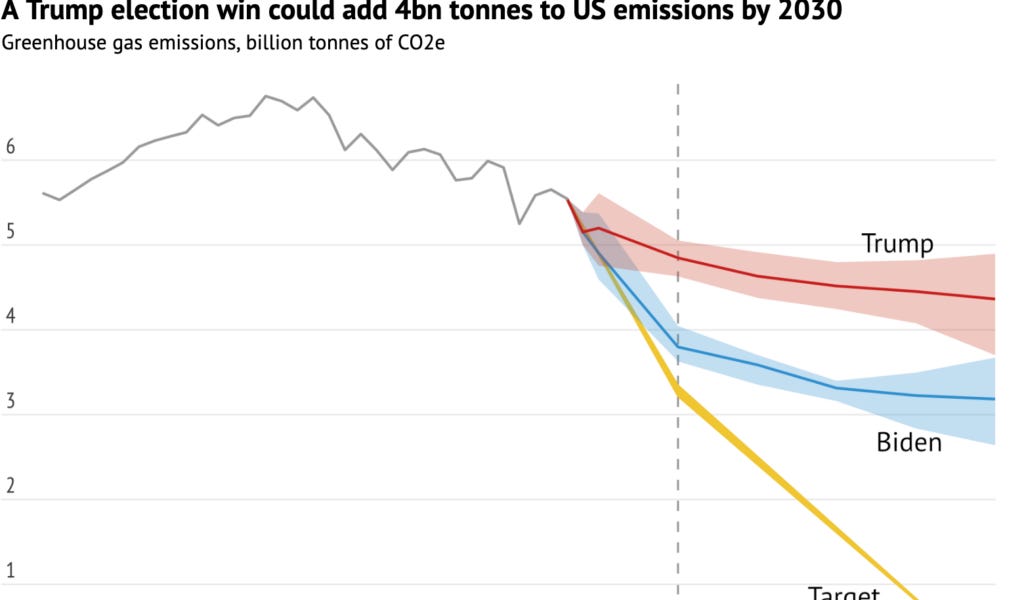
Adam Tooze's Chartbook has a very thorough post out estimating the impact of the 2024 presidential contest on carbon emissions. A top line chart from the piece:

Notably the post focuses its examination on rollbacks to the Inflation Reduction Act (IRA). The piece does not prognosticate on the (more speculative) potential for other impactful policy changes like permitting reform.
Senators Manchin and Barrasso introduced a new bipartisan energy permitting reform bill. The difficulty in permitting and thus building new transmission lines has been a long standing pain point in new power generation. A nice summary of the bill from the Niskansen Center.
The Energy Permitting Reform Act of 2024 aims to streamline and expedite the energy project approval process. By shortening judicial review timelines and accelerating leasing and permitting decisions, the bill seeks to facilitate the development of both onshore and offshore energy resources. The Act mandates regular offshore wind and oil lease sales, modernizes geothermal and hardrock mining processes, and sets increased production targets for renewable energy. It introduces reforms for electric transmission planning to safeguard electric reliability and enhance grid resilience.
These suggestions are broadly in line with the energy call to action I helped author in a previous gig. See that whitepaper below.
This post is part of a series. Part 1 lives here.
This post includes three sections:
California's dramatic batter transition.
Impact of the next POTUS
Potential of permitting reform
This post is part of a series. Part 1 lives here.
California has seen dramatic uptick in its grid scale battery adoption.

Skeptics might point out that the total percentage of grid reliability is still trivial. Yet these signals of accelerated action suggest the energy transition is proceeding along an S-curve in key sectors like solar and adjacent sectors like grid scale batteries to deal with solar's intermittency issue.
Adam Tooze's Chartbook has a very thorough post out estimating the impact of the 2024 presidential contest on carbon emissions. A top line chart from the piece:

Notably the post focuses its examination on rollbacks to the Inflation Reduction Act (IRA). The piece does not prognosticate on the (more speculative) potential for other impactful policy changes like permitting reform.
Senators Manchin and Barrasso introduced a new bipartisan energy permitting reform bill. The difficulty in permitting and thus building new transmission lines has been a long standing pain point in new power generation. A nice summary of the bill from the Niskansen Center.
The Energy Permitting Reform Act of 2024 aims to streamline and expedite the energy project approval process. By shortening judicial review timelines and accelerating leasing and permitting decisions, the bill seeks to facilitate the development of both onshore and offshore energy resources. The Act mandates regular offshore wind and oil lease sales, modernizes geothermal and hardrock mining processes, and sets increased production targets for renewable energy. It introduces reforms for electric transmission planning to safeguard electric reliability and enhance grid resilience.
These suggestions are broadly in line with the energy call to action I helped author in a previous gig. See that whitepaper below.
This post is part of a series. Part 1 lives here.
No comments yet